
OBITUARY
James Lewis Hamrick III
February 26, 1942 – June 30, 2026
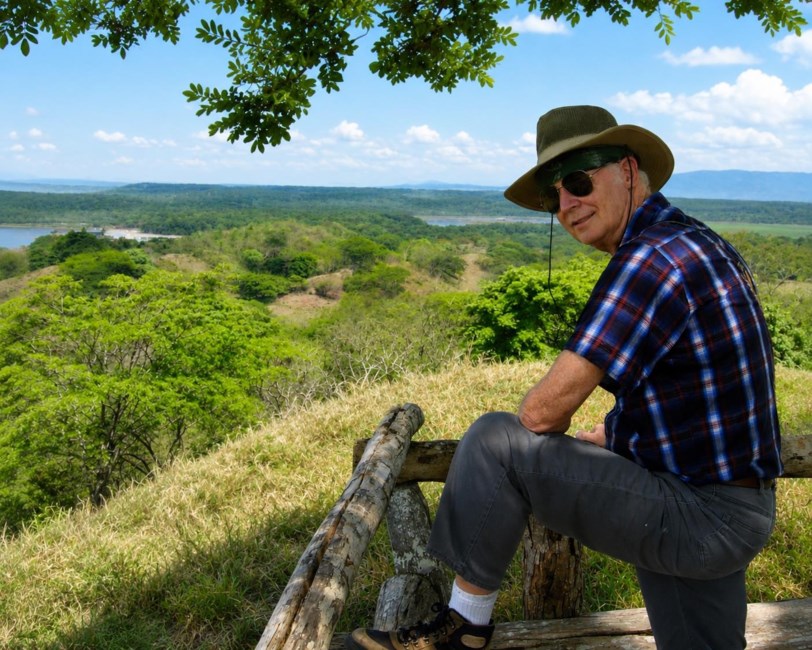
Born in Richmond, Jim Hamrick grew up in Hopewell, Virginia. He earned a bachelor’s degree in forestry from North Carolina State University in 1964 and a master’s degree in forest genetics from the University of California at Berkeley in 1966. He received his doctoral degree in genetics, also from Berkeley, in 1970.
Jim began his academic career at the University of Kansas, which he joined as an assistant professor in 1971. He rose through the ranks, achieving his professorship in 1980, and served as head of the Department of Botany there in 1984-85 before coming to UGA the following year. In recognition of his many contributions to science, Jim was named a Fellow of the American Association for the Advancement of Science in 1989.
At UGA Jim served as a research professor from 1990 to1995 and head of the department from 1992 to1995. In 2000 he was recognized as a distinguished research professor and was honored as a USG Regents’ Professor in 2008.
Jim was an associate editor for numerous academic journals, including Evolution, Heredity, Conservation Genetics and Molecular Ecology. In 1996, he was president of the American Genetics Association, and from 2000 to 2006 he was a member of the U.S. National Committee for the International Union of the Biological Sciences. A passionate advocate for tropical biology, Jim served as UGA’s representative to the Organization for Tropical Studies from 1987 until his retirement in 2015. Jim was a devoted supporter of OTS, serving on the OTS executive committee and various advisory boards, teaching OTS courses, and conducting much of his research at OTS stations, with a particular love for Palo Verde Research Station in Guanacaste Province. Jim and many of his graduate students and postdoctoral advisees conducted research primarily at the Smithsonian Tropical Research Institute’s Barro Colorado Island in Panama and throughout much of Costa Rica.
During his career Jim taught numerous courses, including Plant Variation and Evolution, Natural History of Georgia Plants and Advanced Population Genetics. He was recognized in 2010 with the Innovation in Graduate Education Award and is the recipient of many research grants from the National Science Foundation, the National Institutes of Health, the U.S. Department of Agriculture, the National Park Service and the Environmental Protection Agency.
He was the author or co-author of nearly 300 articles in peer-reviewed journals and was co-editor with former UGA faculty member John Avise of the book Conservation Genetics: Case Histories from Nature (1996).
Throughout his career, Jim was an exceptionally dedicated mentor to more than 30 Master’s and Ph.D. students as well as to countless students both within his academic institution and visiting students, who sought his help. Even if he received no official credit for doing so, Jim never turned away a student in need. No one ever worked harder for their mentees. In more than one instance, Jim would come to the aid of a graduate student whose project was on the precipice of failure. In doing so he helped countless scholars launch illustrious careers both within and without academia.
Jim had many loves in his life. Among them were blues guitarists such as B.B. King, Muddy Waters, Michael Burks and his cousin Tom Gray, all of whom preceded Jim in death. With little musical talent of his own, good music was a salve he often applied and which frequently drew him to the dance floor. Jim’s artistic outlet was hooking rugs; a dying art form taught to him as a small child by his grandmother. He hooked rugs throughout his life, with the subject matter usually including landscapes of beloved research sites and plants. For many years, Jim bestowed hooked rugs to his finishing Ph.D. students of their research sites and/or organisms.
Another of Jim’s great loves was watching sports, most particularly college sports. One thing that he could not abide was fans who left a game early. This philosophy applied to University of Georgia football games in which the team was down by double digits late in the fourth quarter, with a driving rain and temperatures in the upper 30s. Jim Hamrick would remain resolutely in his assigned seat. It was not a matter of harboring Pollyannaish expectations for a positive outcome, if nothing else Jim was a resolute realist. Rather it was a sign of respect for the players, the coaches, the staff and for the game itself. A collegiate athlete himself (Jim was Captain of the Track and Field team at NC State) his feeling was if they are still out there playing the game, we should support them by watching until the very end.
Jim also had a passion for turtles. All sorts of turtles. Ignoring all state and federal laws that prohibited it, Jim provided a loving home to every injured turtle that ever came his way. This included an ancient and battered box turtle named Les whose eye infection left him blind and starving in the woods. When medication restored his vision and Les began to recover, Jim put the old boy in a pen with a female turtle for company. Five months later a baby hatchling showed up, proving that Les had indeed fully recovered, and not just his eyesight.
Most of all Jim loved trees. All trees. When a tree died, Jim was often ready with his chainsaw, splitting wedge and his beat-up old Subaru, whose terrible condition would have made it impossible to legally drive in most States other than Georgia. Operating under the philosophy that in death that tree could either decay as it was slowly converted into carbon dioxide by fungi, or Jim could give it an honorable cremation in his wood stove. He chose the latter whenever possible.
But the trees Jim loved most were the living ones. White Firs and Ponderosa Pines from the western montane forests, Bristlecone Pines of the Great Basin National Park, and the magnificent trees of the tropics. Jim’s introduction to Central America came with Steve Hubbell’s invitation to work at Barro Colorado Island in the middle of the Panama Canal. Jim continued tropical work for many years in Costa Rica. Of the many extraordinary trees he and his students studied, his great love was for the Guanacaste tree (Enterolobium cyclocarpum), the national tree of Costa Rica. He mapped and studied literally hundreds of trees. Trees that he revisited every year for decades, coming to know them as individuals, as they shared their history with him. He took great joy communing with his trees and all the wildlife he would encounter during his time in the tropical dry forest. One of Jim’s final requests was to transition from this world with an Enterolobium seed pod in his hands.
Jim imparted this love for nature to his daughter and grandchildren. On walks in the woods and botanic gardens, he taught them to observe and appreciate the often-overlooked details: the difference in shape between pine and fir needles, how a flower’s shape indicates its pollinators, and the vanilla scent of sun-warmed Ponderosa bark. With his grandchildren, he spent hours assembling and enjoying binders full of flora and fauna photos sparking in them a deep and enduring passion for the natural world.
All the love that Jim gave in life returned to him in the form of the exceptional care he received at home while managing Parkinson’s disease. Jim’s care team incorporated especially trained aids to offer a positive approach to care and to foster independence in an emotionally and physically safe environment. Jim enjoyed the accessibility of his home surrounded by peace, beautiful gardens, his beloved cats and tortoise, laughter, good food, music, and a deep love and respect for who he was.
Jim is survived by his wife Paola A. Barriga Albuja, daughter Jenna Hamrick Young, her husband Jonathan Young and grandchildren Rohan, Harper, and Stella; his brothers Tom and Bob, and nephews Bob, David, and Kevin and nieces Donna, and Marie.
The family asks that in lieu of flowers, appreciations can be made to the UGA Plant Biology Research and Education Fund which benefits the department through graduate and undergraduate scholarships, fellowships, travel, and publication costs. A memorial service will be held at a later date.
And if you are moved to do so, put on some blues music and get up and dance.
Show your support
Add a Memory
Share Obituary
Get Reminders
Services
SHARE OBITUARYSHARE
- GET REMINDERS
v.1.18.0